Two years ago, PARSOL released a survey that made us uncomfortable.
We had asked sixty-one formerly incarcerated members about voting — this was in response to Pennsylvania House Resolution 47, which directed the Pennsylvania Joint State Government Commission to study voting patterns among released Pennsylvanians. More than half (54.2%) had been told their criminal record barred them from voting. A quarter of those people believed it and stayed home on Election Day. Most troubling: 26% had heard that incorrect information from a Department of Corrections employee, a parole officer, or a probation officer.
The Joint State Government Commission cited our survey in its official July 2024 report. But sixty-one people isn’t a statewide picture. So we built one.
What we did
Starting from the February 2026 PA Megan’s Law registry — 17,533 individuals who are permanently housed and fully compliant — we cross-referenced against the full Pennsylvania SURE voter file: 8.9 million records, all sixty-seven counties. The matching algorithm required birth year plus one corroborating identifier. We used conservative thresholds to avoid false positives, which means our numbers probably understate the actual gap.
What we found
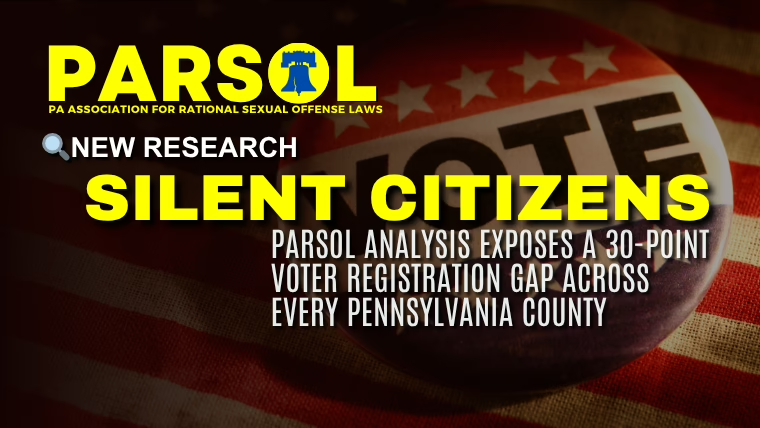
The registry population registers to vote at 61.99%. The general eligible population: 92.23%. A 30-point gap. Not close. And it exists in every county we looked at, from Philadelphia to Forest County.
6,665 people have the legal right to vote and are not in the voter file at all.
Key Statistics

Why it happens
PA Megan’s Law has nothing to do with voting rights. 42 Pa.C.S. Chapter 97 requires registration, address verification, and community notification. It has no residency restrictions, no proximity restrictions, and no location restrictions. Rights come back automatically upon release — no application, no petition to a governor.
The confusion is understandable. Across the country, felony disenfranchisement law is a patchwork. In Florida, you have to pay all your court costs before your rights are restored, which effectively maintains a lifetime ban for many people who can’t afford it. Tennessee and Alabama have some of the broadest permanent bans in the country. Four million Americans are currently barred from voting because of a felony conviction. Someone walking out of a Pennsylvania prison has every reason to assume the same rules apply here. In most states, they’d be right.
Pennsylvania is the exception. And that exception is invisible until someone names it.
The polling place problem
There’s a second barrier the survey didn’t fully capture. About 45–55% of Pennsylvania polling places are at schools or churches. Parole and probation conditions routinely restrict exactly those locations. A person under supervision who’s assigned to vote at an elementary school has a real choice: risk a supervision violation, ask their parole agent for permission (which may not come in time, or at all), or just not vote.
The frustrating part: the solution already exists. Pennsylvania Act 77 of 2019 allows any registered voter to request a mail ballot without giving a reason. Vote at home, return by mail. For someone under supervision with a restricted polling place, that’s a complete solution. The problem is that nobody’s delivering this information to the people who need it.
What PARSOL is doing
We’re launching the PA Registry Civic Engagement Initiative. Three components:
Know Your Vote — a targeted communications campaign through attorney networks, treatment providers, and PARSOL’s community channels. Four questions every registry individual should be able to answer: Do I have the right to vote? Am I registered? What do I do if I’ve moved? And if my polling place is restricted, how do I vote?
County-Targeted Outreach — prioritization, starting with ten counties with the largest combined gaps: Philadelphia, Dauphin, Allegheny, York, Delaware, Lancaster, Montgomery, Erie, Clearfield, and Westmoreland and key counties that PARSOL has key staff (Dauphin, Luzerne, Schuylkill.)
Annual Monitoring — tracking the gap year over year, publicly, so progress is measurable and we can be held to it.
The full report is available below. County-by-county data, complete methodology, policy recommendations. If you’re a funder, a legislator, an election administrator, or an allied organization, we’d like to talk. The gap is real, it’s documented, and it’s fixable.